JoJo New Anime Faces Research Challenges, Plans Over 5,000 Horse Animation Cuts Across the Series: Director Yasuhiro Kimura Interview Part 2
To celebrate the worldwide exclusive early streaming release of Steel Ball Run: JoJo’s Bizarre Adventure, the second part of the official interview with director Yasuhiro Kimura has been released.
©LUCKY LAND COMMUNICATIONS / Shueisha, JoJo’s Bizarre Adventure SBR Production Committee
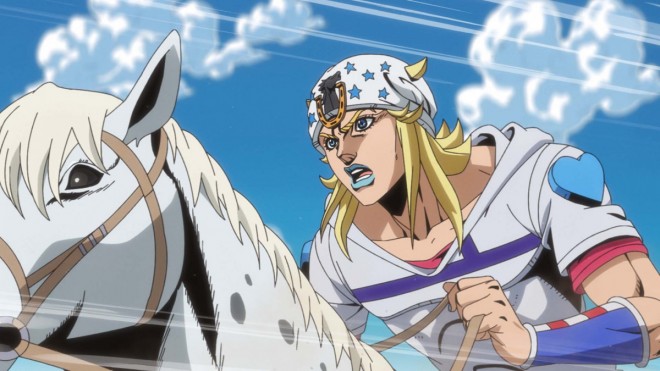
Set in late 19th century America, the seventh part of the series follows the first ever horseback race across North America. Johnny Joestar, a former prodigy jockey who is now paraplegic, teams up with the mysterious outlaw Gyro Zeppeli as they compete in a race filled with massive prize money and hidden conspiracies. The original manga was serialized from January 2004 to April 2011.
Emphasizing the Journey Across America
©LUCKY LAND COMMUNICATIONS / Shueisha, JoJo’s Bizarre Adventure SBR Production Committee
ーーThe story centers on a transcontinental race. What kind of visual direction did you focus on?
Kimura
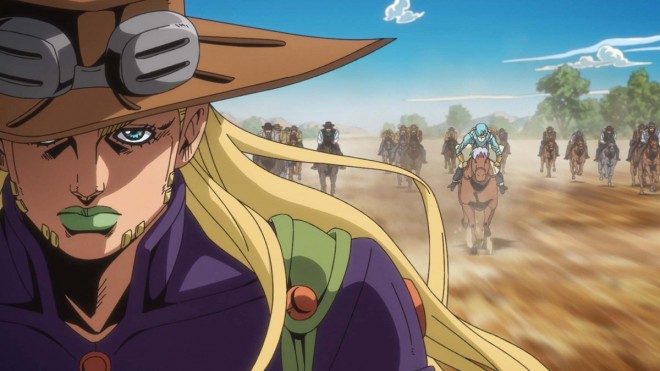
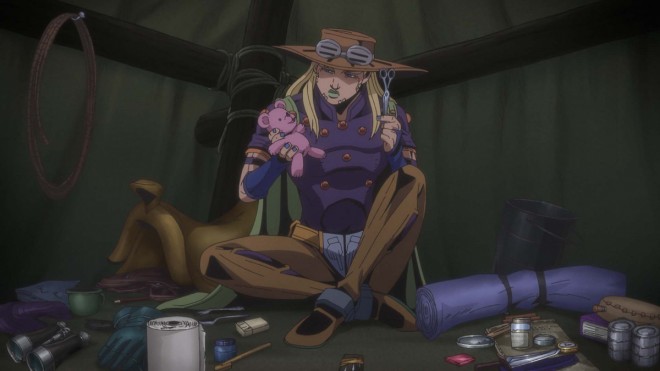
Since this is also a road movie across America, we placed great importance on the feeling of travel. I noticed even in Golden Wind that the JoJo series surprisingly has very few scenes of characters eating during their journey. Whenever they try to eat, they usually get attacked by enemies. So this time, even if it wasn’t in the original, I wanted to include scenes like camping, cooking, and eating as much as possible. I wanted to properly convey the atmosphere of a journey.
From an art perspective, there are places with buildings and also vast wilderness areas. We focused on creating backgrounds that allow viewers to feel that scale. I hope audiences enjoy how the visual impression changes depending on the region.
Challenges of Recreating 1890s America
©LUCKY LAND COMMUNICATIONS / Shueisha, JoJo’s Bizarre Adventure SBR Production Committee
ーーWe heard that researching materials for 1890s America was difficult.
Kimura
It was extremely challenging. In Japan, it’s very hard to find reference materials, and even online there isn’t enough information. So we brought in a historical consultant. We had to research clothing, customs, food, and architecture, and determine what existed at the time and what did not. Also, there are very few experts on the American West in Japan, so we asked Professor Hidekazu Nishikawa, who specializes in American history, to supervise.
Creating the Race Experience
©LUCKY LAND COMMUNICATIONS / Shueisha, JoJo’s Bizarre Adventure SBR Production Committee
ーーWhat aspects did you focus on most in the “1st STAGE”?
Kimura
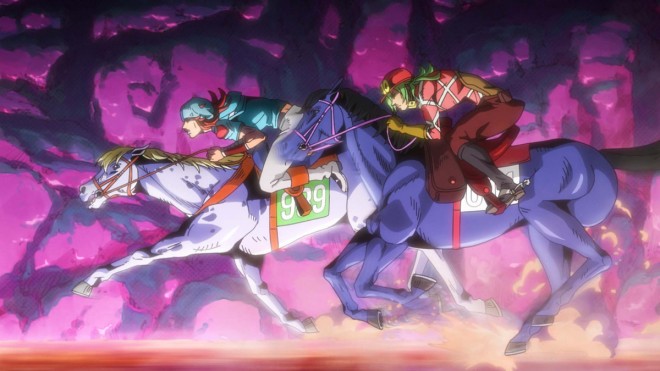
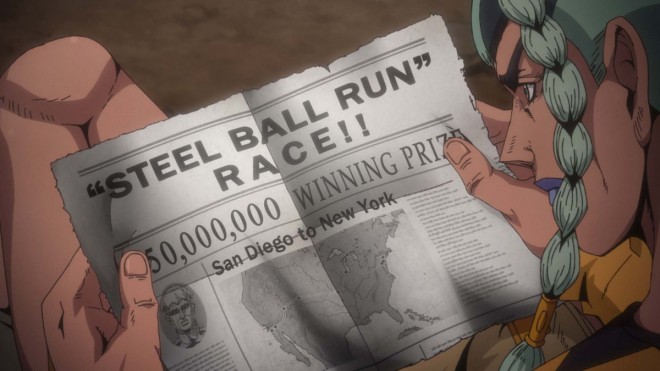
The fact that Steel Ball Run is fundamentally a race story. We carefully developed how to portray the sense of speed and how to incorporate commentary. We especially put a lot of effort into the latter half of the race.
The Challenge of Animating Horses
©LUCKY LAND COMMUNICATIONS / Shueisha, JoJo’s Bizarre Adventure SBR Production Committee
ーーSince this is a horseback race, how did you approach depicting horses?
Kimura
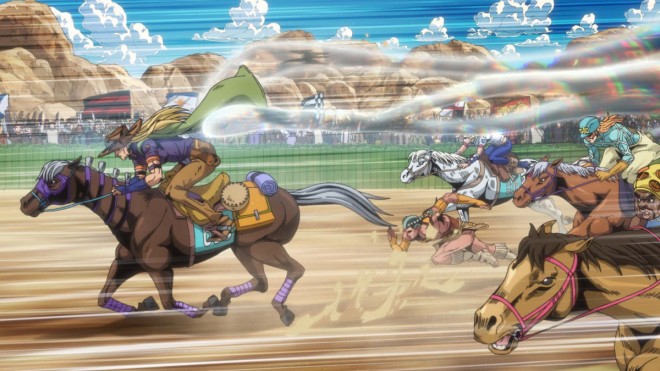
Horses were the first major challenge. My job wasn’t to simply draw high quality horses, but to create a system that allows us to maintain consistent quality throughout the entire production. If this were only adapted as a single “1st STAGE,” we might have aimed for even higher quality. But since this series will continue, the priority was to build a system that anyone can draw and that keeps the quality stable.
ーーDid you use any references for horses?
Kimura
I actually tried horseback riding myself and realized that a horse’s back is surprisingly triangular, and your viewpoint is quite high and unstable. I thought, “It’s crazy to cross America on something like this!” (laughs)
Interviewer: (laughs)
Kimura
However, in the anime, we are not simply recreating realistic horses. We studied how horses run, but the more we researched, the more complex it became. It’s impossible to fully reproduce that, so we simplified the elements and pursued a style of movement suited specifically for Steel Ball Run. Across the entire series, we are expecting over 5,000 horse animation cuts, so it’s not realistic to handle everything with hand drawn animation. We calculated costs and manpower, and designed the system to maintain quality as much as possible.
Balancing 3DCG and Hand Drawn Animation
©LUCKY LAND COMMUNICATIONS / Shueisha, JoJo’s Bizarre Adventure SBR Production Committee
ーーHow do you differentiate between 3DCG and hand drawn animation?
Kimura
Basically, when the horse is shown fully including its legs, we often use 3DCG. However, for specific angles where characters are visible, we use hand drawn animation. By limiting hand drawn work to necessary cuts and using 3DCG for the rest, we can balance the workload.
Bringing Gyro’s Steel Balls to Life
©LUCKY LAND COMMUNICATIONS / Shueisha, JoJo’s Bizarre Adventure SBR Production Committee
ーーMany fans are curious about how Gyro’s steel balls are depicted.
Kimura
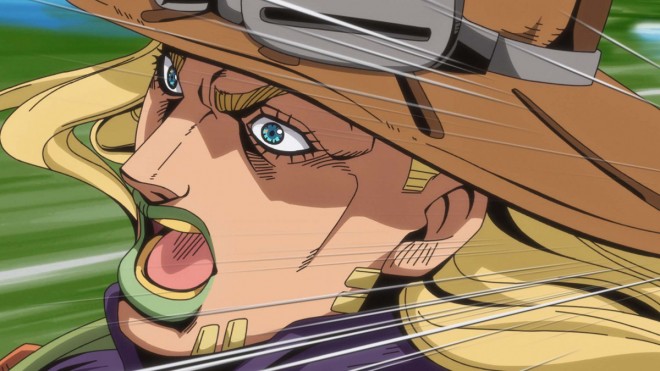
We use both hand drawn animation and 3DCG for the steel balls. In the “1st STAGE,” we also incorporated ripple like effects. This is an original element not present in the manga. We wanted to create a connection with previous series. It’s not exactly the same as Ripple, but I think the sound design also gives a similar impression.
At the same time, we aimed to convey the weight and texture of the steel balls. Sound effects director Yasumasa Koyama put a lot of effort into figuring out how to create the sound of rotation. I heard he even bought actual steel balls and recorded real sounds (laughs).
Source : ORICON NEWS

Related News
Steel Ball Run Anime Direction Emphasizes Manga Panel Size and Sound Effects: Director Yasuhiro Kimura Interview
The Steel Ball Run anime highlights manga panel size and sound effects, as director Yasuhiro Kimura shares ...
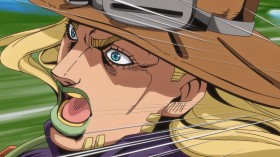
JoJo’s Bizarre Adventure Part 7: Steel Ball Run to Stream Exclusively on Netflix from March 19, 2026, PV Reveals Sandman and Po...
JoJo’s Bizarre Adventure Part 7: Steel Ball Run is set to stream exclusively on Netflix worldwide starting ...
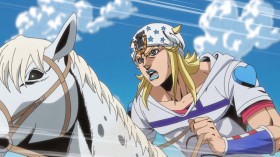
New Key Visual for JoJo’s Bizarre Adventure Part 7 Revealed as Jump Festa Announces Steel Ball Run Events
The new key visual for Steel Ball Run, the latest entry in the JoJo’s Bizarre Adventure anime series coming...
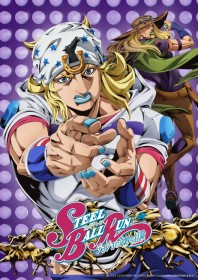
Steel Ball Run JoJo’s Bizarre Adventure Anime PV Reveals Cast of 5 Main Characters for 2026 Netflix Release
The teaser PV for Steel Ball Run JoJo’s Bizarre Adventure has been released, confirming its worldwide Netfl...
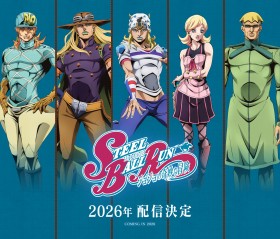
Anime JoJo’s Bizarre Adventure: Steel Ball Run Unveils Cast , Shogo Sakata, Yohei Azakami, and Kaito Ishikawa to Star
Anime JoJo’s Bizarre Adventure: Steel Ball Run announces its main cast, including Shogo Sakata as Johnny Jo...
Steel Ball Run: JoJo’s Bizarre Adventure to Stream Worldwide on Netflix
Netflix has announced that Steel Ball Run: JoJo’s Bizarre Adventure, the latest installment of Hirohiko Ara...
JoJo’s Bizarre Adventure: Steel Ball Run Event Set for September 23 with Live Stream
A special event revealing new details for the anime adaptation of JoJo’s Bizarre Adventure: Steel Ball Run ...