


[This Week in Japan] Manga Creator Hisashi Eguchi Faces Backlash Over Tracing Scandal
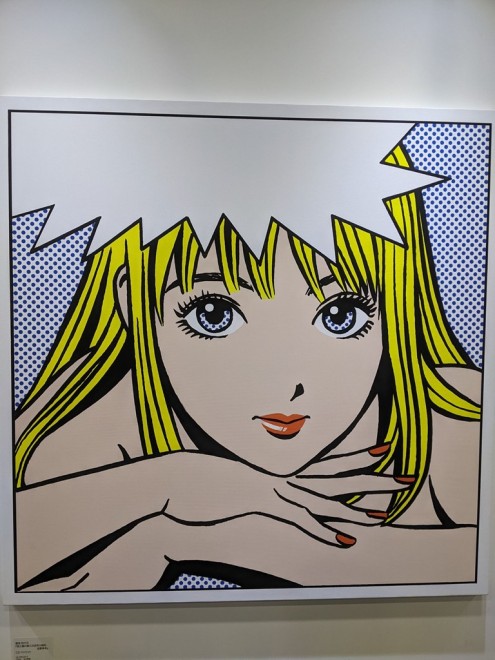
Manga Stop!! Hibari-kun! illustration : Photo taken by the Editor at the Hisashi Eguchi exhibition.
This week, Japan was abuzz over a controversy involving manga artist and illustrator Hisashi Eguchi (JP: 江口寿史), known for works such as Stop!! Hibari-kun! (ストップ!! ひばりくん!). The issue centers on Eguchi’s alleged tracing of photos commonly referred to in Japan as “torepaku,” a slang term for tracing and plagiarizing someone else’s work.
Eguchi’s illustrations are celebrated for depicting scenes that feel as if they were captured from everyday city life. His charming, life-sized portrayals of girls (drawn without the exaggerated features typical of manga or anime) have earned him wide popularity. His works are known for their distinctive, snapshot-like visual style that resembles turning candid photographs into illustrations.
It came to light that Eguchi had traced a photograph posted on Instagram without permission and turned it into an illustration. The illustration in question was created for the Chuo Line Culture Festival 2025 poster.
The matter was uncovered when model Kyu Kanai, whose photo had been used as a reference, noticed that her Instagram picture had been directly copied and contacted Eguchi. He later admitted on X (formerly Twitter) that he had “drawn the piece based on a beautiful profile I saw on Instagram” and reposted the work after obtaining her permission, though the initial usage had been unauthorized.
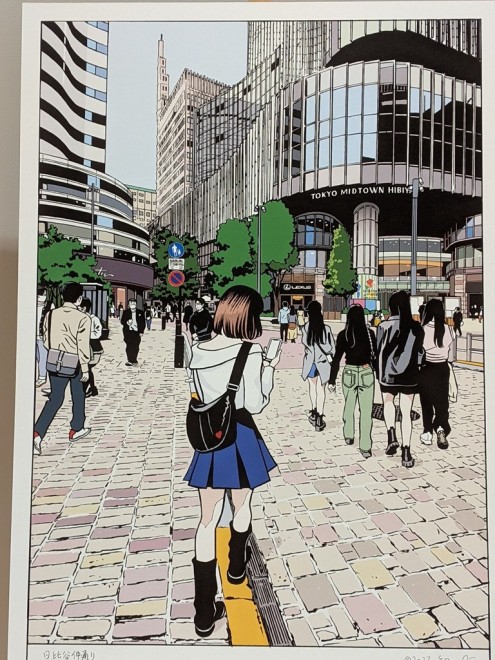
Photo taken by the Editor at the Hisashi Eguchi exhibition.
This statement only fueled public outrage. Many social media users questioned, “Why was the image used commercially before getting permission?” The poster was quickly withdrawn, and scrutiny extended to Eguchi’s previous works, with new accusations of tracing emerging.
Companies such as eyewear brand Zoff and family restaurant chain Denny’s, both of which had commissioned Eguchi for past advertising illustrations, announced that they were investigating and suspending the use of his artworks. As a result, online “special investigation groups” have been combing through his past portfolio to determine “how much of Eguchi’s work is truly original.”
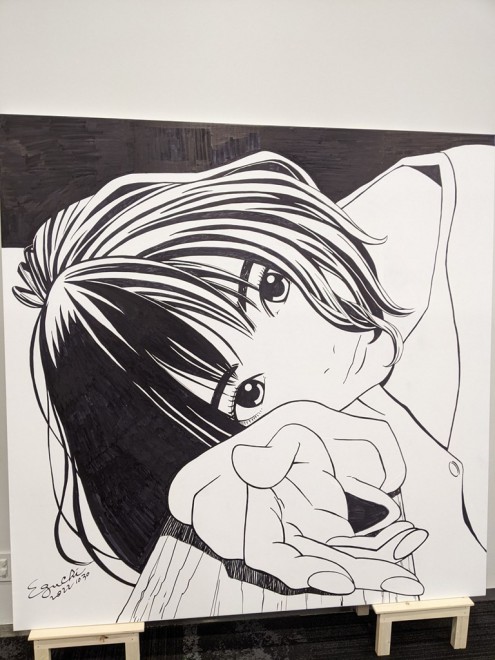
Photo taken by the Editor at the Hisashi Eguchi exhibition.
This statement only fueled public outrage. Many social media users questioned, “Why was the image used commercially before getting permission?” The poster was quickly withdrawn, and scrutiny extended to Eguchi’s previous works, with new accusations of tracing emerging.
Companies such as eyewear brand Zoff and family restaurant chain Denny’s, both of which had commissioned Eguchi for past advertising illustrations, announced that they were investigating and suspending the use of his artworks. As a result, online “special investigation groups” have been combing through his past portfolio to determine “how much of Eguchi’s work is truly original.”
Why Did the Controversy Escalate So Dramatically?
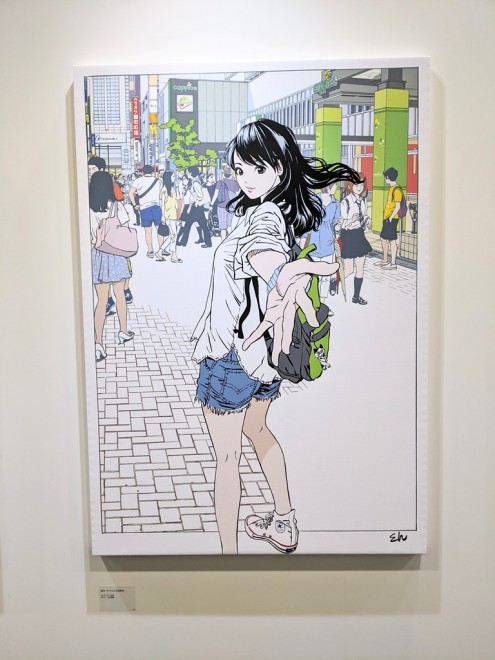
Photo taken by the Editor at the Hisashi Eguchi exhibition.
Cases of manga artists being accused of tracing are not new in Japan. On the country’s early internet forum “2channel,” there was once a heated discussion about Slam Dunk creator Takehiko Inoue, who was said to have used basketball magazine photos as references for scenes in his manga. However, upon closer examination, most of these instances were more about referencing composition rather than outright tracing.
In Eguchi’s case, several factors amplified the controversy, including the influence of social media and Japan’s growing awareness of copyright and portrait rights:
・The source material belonged to a private individual.
・The traced image was used commercially as an advertisement illustration labeled as “his own work.”
・The entire sequence of events unfolded publicly and transparently.
・Eguchi’s own remarks aggravated the situation.
・Other users began pointing out similar issues.
・People started digging up past works for comparison.
・The scandal spread to the companies that had commissioned his illustrations.
Adding to the backlash, Eguchi’s past comment that “copying someone else’s photo directly shows a lack of imagination” resurfaced, drawing accusations of hypocrisy. With no official apology issued and only the deletion of his social media posts, the outrage has continued to simmer online.

Related News
[Voice Actor] Marika Kono Reflects on 7 Years with Uma Musume and the Journey of Silence Suzuka
Voice actress Marika Kono updated her X account on the 3rd, sharing a photo of herself as Uma Musume taken ...
![[Voice Actor] Marika Kono Reflects on 7 Years with Uma Musume and the Journey of Silence Suzuka](/upimg/thumb/1000/1647/img280/cf8db159aa8505b506355e7b2cc6bac8.jpg)
Ayana Taketatsu Amazed by Aura’s Popularity in Frieren: Beyond Journey’s End — Praised for the “Die by Your Own Hand” Scene: “T...
Ayana Taketatsu reflects on Aura’s enduring popularity at the Frieren: Beyond Journey’s End 2nd Anniversary...

[Editor’s Picks] Too Many Anime? Broadcast Delays Become an "Unusual Situation" as Six TV Series Are Postponed and One Canceled
As the summer anime season concludes and new titles from the fall season begin airing, the industry faces a...
![[Editor’s Picks] Too Many Anime? Broadcast Delays Become an "Unusual Situation" as Six TV Series Are Postponed and One Canceled](/upimg/thumb/6000/6362/img280/Fall-Anime-Broadcast-Delays.jpg)
[Editor's Picks] Predicting the Next Manga Award 2025
The 2025 Next Manga Award results will be announced on September 18 at 7:00 p.m. JST, exactly 24 hours afte...
![[Editor's Picks] Predicting the Next Manga Award 2025](/upimg/thumb/6000/6235/img280/next-manga-awards2025.jpg)
[Editor's Picks] Jujutsu Kaisen Modulo Runs for Six Months with 3 Volumes: Set 68 Years Later with Sci-Fi Elements
Jujutsu Kaisen Modulo, set 68 years later in 2086, follows Yuta Okkotsu’s descendants in a six-month spinof...
![[Editor's Picks] Jujutsu Kaisen Modulo Runs for Six Months with 3 Volumes: Set 68 Years Later with Sci-Fi Elements](/upimg/thumb/6000/6185/img280/jujutsu-kaisen-modulo.jpg)
[Editor's Picks] What Is an Anisong? A Look Back from the Past to the Present
Anisong (Anime Song) explained with personal insights and history from Astro Boy to YOASOBI, including tie ...
![[Editor's Picks] What Is an Anisong? A Look Back from the Past to the Present](/upimg/thumb/6000/6084/img280/anisong-1.jpg)
[English Translation] KADOKAWA Announces Groundbreaking Policy Allowing YouTube Use of Anime Clips and Commentary
KADOKAWA allows legal use of anime clips and commentary on YouTube for four new titles from July 2025, incl...
![[English Translation] KADOKAWA Announces Groundbreaking Policy Allowing YouTube Use of Anime Clips and Commentary](/upimg/thumb/5000/5546/img280/KADOKAWA-YouTube-Clips-Guidelines-1.jpg)
[Editor’s Picks] Why Gundam Became a Legendary Franchise: The Impact of G Gundam and Gundam Wing
Discover how G Gundam and Gundam Wing reshaped the Gundam franchise into a global phenomenon, attracting di...
![[Editor’s Picks] Why Gundam Became a Legendary Franchise: The Impact of G Gundam and Gundam Wing](/upimg/thumb/5000/5524/img280/Gundam-w-30th.jpg)