Inside Takopi's Original Sin with Reina Ueda & Konomi Kohara [INTERVIEW]
Balancing Resignation and Emotion: The Challenge of Character Work
Q: How did you approach building your characters for this series?
Reina Ueda:
During the recording of the teaser trailer, I remember being directed after the test run to emphasize “resignation.” I think that stuck with me as the base tone for Shizuka throughout the series. That said, Shizuka is actually quite expressive in subtle ways. For example, she smiles when she’s with her dog Chappy. And when she sees glimpses of salvation or hope, her emotions—joy, anger, sadness, and even happiness—become more apparent.
She also tends to overreact when someone expresses an opposing opinion. So even though she may seem emotionally subdued, she actually experiences a wide range of feelings. My challenge was to strike the right balance: not to express too much, but also not to flatten her into someone completely emotionless or devoid of desire.
Another thing I focused on was making her seem like someone who doesn’t really listen to others, or doesn’t even have the sense to try understanding what someone else is feeling. If I could portray that, I felt it would create a clear sense of disconnect in her conversations with others—a dissonance, you could say.
I also wanted to keep her moral compass somewhat ambiguous. There are moments when Shizuka might come across as “bad,” but I tried to make her actions feel impulsive and emotionally gray, rather than outright wrong or right. I approached my performance with the hope that I could portray her without making her morality too clear-cut.
Q: It's easy to want to help a character like her—but you held back from projecting that feeling too much?
Ueda:
Yes, but I still understood where Shizuka was coming from. I’ve also had phases in my life where things didn’t go well and communication just didn’t work. It felt like I was endlessly digging into the ground. So in that sense, I related to her.
Of course, I wouldn’t go as far as to say I understood everything she felt—that would be presumptuous. But I did draw from those memories: “I used to feel like this,” “That’s how it was back then.” I performed her while drawing on those feelings, so I think that’s why I didn’t end up portraying her from a place of light looking into darkness.
Q: And how about you, Kohara-san?
Konomi Kohara:
As I mentioned earlier (in the first part of the interview), I felt the need to “stay close” to Marina—but even so, I couldn’t claim to fully understand her. I haven’t gone through anything like what she did myself…
Marina has a lot of emotionally charged scenes—she gets angry, she cries. Those emotions are explosive, so in a way, almost any delivery can “work.” So I practiced those lines a lot at home. But when we were actually performing together, I thought that maybe it was better to let those spontaneous moments happen—because they might come out even more raw and lifelike.
That said, I did have one major insecurity. I wondered if a character who expresses so much anger needed someone with a more forceful voice. My voice is on the higher side, so I worried whether I could capture those extreme emotional shifts convincingly.
Even with that anxiety, I threw myself into the recording of Episode 1 and gave it my all. And after we wrapped, I did something I normally wouldn’t do—I asked Director [Shinya] Iino and Sound Director [Jin] Aketagawa, “Why did you choose me for the role?”
They told me, “In anime, people often expect certain types of characters to be voiced by certain types of voices. But that’s just a convention of stylization—real life isn’t like that. Sometimes, someone who doesn’t seem like they’d act that way has the most authentic impact.”
That comment really eased my worries. After that, from Episode 2 onward, I felt more confident and free to explore the role. I received so much help from everyone involved—so many hints that guided my performance. That’s the impression that stayed with me.
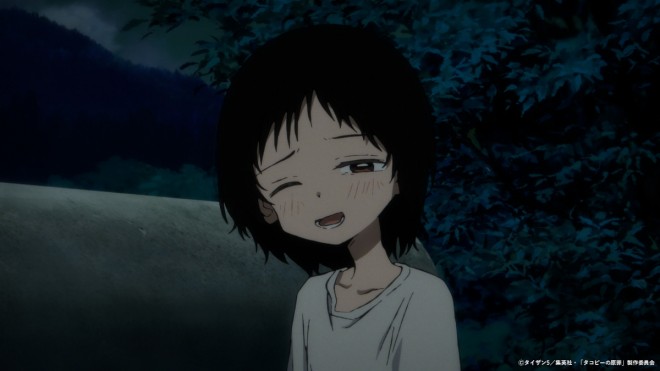
Scene from Takopi's Original Sin © Taizan 5 / Shueisha / "Takopi's Original Sin" Production Committee. Shot in Japan.
Living in the Moment: To Know the Future or Feel the Now
Q: When you perform, do you take into account what happens later in the story? Or do you focus only on the moment?
Ueda:
I intentionally re-read only the parts of the original manga we were recording each time, and didn’t read beyond that. So while I had a general idea of how Shizuka would change over time, I didn’t imagine it too concretely. I think I acted mostly in the moment, focusing on the feelings of each specific scene.
Q: Was that approach unique to this work, or is it how you usually perform?
Ueda:
As the story progresses, I think more and more of Shizuka’s expressions—those we couldn’t see at first—start to come into view. But I never saw her as someone hiding a secret side from others, so I didn’t feel the need to build that sort of layered performance this time.
Q: Kohara-san, how about you?
Kohara:
I’m the type who tends to read ahead in parallel, so I would read what was coming up next and think, “Ah, I see,” as I performed the current scene. I read the entire manga when preparing for the audition, so I should’ve known what happens.
But I didn’t go into every recording session with the full ending burned into my mind—I tried to face each day as it came. Of course, there are actors who can take the whole story into account and strike a perfect balance in their performance, but I’m more of a feeling-based actor. I’m not that technically adept. So I approached each scene by focusing on what the character felt in that exact moment.
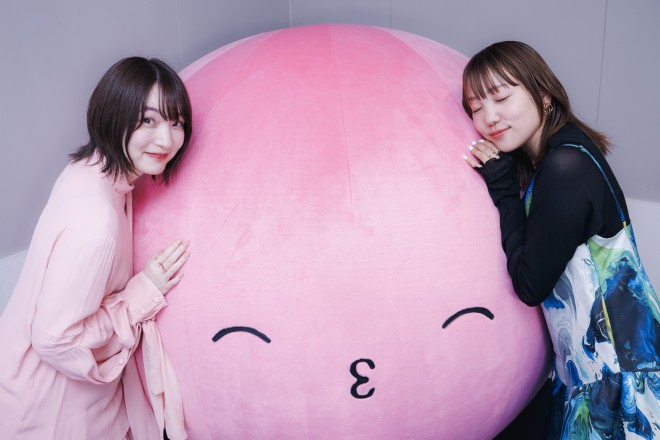
Reina Ueda and Konomi Kohara speak on their roles in Takopi's Original Sin. Interview visual features the two voice actresses (left to right), © Taizan 5 / Shueisha / "Takopi's Original Sin" Production Committee. Shot in Japan.
Source : ORICON NEWS

Related News
Takopi's Original Sin Unveils Main Visual and Full Trailer — All 6 Episodes to Stream Starting June 28
Takopi's Original Sin anime reveals trailer, theme songs by ano and Tele, and starts streaming June 28 with...
.jpg)
Takopi's Original Sin Anime Adaptation Set for 2025 with New Teaser Released
The critically acclaimed manga Takopi's Original Sin will receive an anime adaptation, set to premiere in 2...
.jpg)
‘Takopi’s Original Sin’ Anime Adaptation Announced with Teaser Visual and PV Release
The manga Takopi’s Original Sin has officially been announced for an anime adaptation. Along with this anno...

【Interview】RPG Megido 72 Keeps Its Flame Alive Even After Conclusion: “Music Is a Crucial Element That Builds Narrative”
In February 2025, the mobile RPG Megido 72 celebrated its “7.2-year anniversary.” Although its online servi...

Kana Ichinose Reveals Behind-the-Scenes Secrets of Playing Suletta in Gundam: The Witch from Mercury — “I Didn’t Even Know If S...
Voice actress Kana Ichinose shares a candid and exclusive interview on J:COM STREAM’s anime catch-up site, ...
[InterView Part 1] Takahiro Sakurai Reflects on Playing a Young Suguru Geto in the Jujutsu Kaisen Compilation Film
The theatrical compilation film Jujutsu Kaisen: Hidden Inventory / Premature Death, which condenses all fiv...
![[InterView Part 1] Takahiro Sakurai Reflects on Playing a Young Suguru Geto in the Jujutsu Kaisen Compilation Film](/upimg/thumb/4000/4829/img280/Sakurai-as-Suguru-Geto.jpg)
[InterView Part 2] Takahiro Sakurai on Reuniting with Yuichi Nakamura and Aya Endo in Jujutsu Kaisen: “The Feeling Came Back In...
The theatrical compilation film Jujutsu Kaisen: Hidden Inventory / Premature Death, which condenses all fiv...
![[InterView Part 2] Takahiro Sakurai on Reuniting with Yuichi Nakamura and Aya Endo in Jujutsu Kaisen: “The Feeling Came Back Instantly”](/upimg/thumb/4000/4830/img280/Sakurai-as-Suguru-Geto-2.jpg)
[Interview] A “Gundam” That Doesn't Fight: The Vision Behind Osaka Expo’s Sole IP Pavilion Promoting Peace Through Mobile Suits
At Expo 2025 Osaka, Kansai—where companies from across industries gather under the theme “Designing Future ...
![[Interview] A “Gundam” That Doesn't Fight: The Vision Behind Osaka Expo’s Sole IP Pavilion Promoting Peace Through Mobile Suits](/upimg/thumb/4000/4612/img280/GUNDAM-PAVILION (6).jpg)
INTERVIEW: Is “Manga Is Hugely Popular Worldwide” Really True? Overseas Realities, Hidden Challenges, and What’s Needed to Boos...
Anime and manga are often touted as Japan’s proud, globally beloved cultural exports. However, particularly...