Kenshi Yonezu's "BOW AND ARROW" Music Video — A Commentary on Yuzuru Hanyu's Skating for the TV Anime Medalist Opening Theme
Expressive Choices in “BOW AND ARROW” and Medalist
Difficult jumps are typically placed early in the program when stamina is highest. In a short program limited to 2 minutes and 50 seconds, skaters must include seven technical elements. For this reason, the first jump usually happens around the 20-second mark. At the PyeongChang Olympics and the 2020 Four Continents—where Hanyu achieved the Super Slam—his first jump occurred around 23 seconds in.
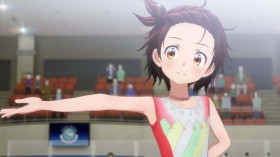
But in BOW AND ARROW, the quad lutz comes at about 45 seconds after movement begins. Why? Because Hanyu matched the timing of a jump by the character Hikaru Okazaki in the opening sequence of the anime Medalist.
This meant he had to fit six more technical elements into the remaining two minutes—an immense challenge he willingly accepted.
Another reason for including the quad lutz was the manga’s own depiction of Jun Yodaka landing the same jump. Hanyu’s deep respect for Medalist, a story centered on competitive figure skating, is evident throughout.
3A (Triple Axel)
The second jump is a triple axel, a jump Hanyu is known for mastering. But that doesn’t mean it’s easy.
He approaches with a short entry and performs a “counter”—a difficult turn—before launching directly into the jump. This means he transitions from backward to forward and immediately jumps, a sequence that’s hard to control and land.
He lands the jump in perfect sync with a sparkling chime in the music, then seamlessly transitions into a twizzle—spinning quickly on one foot.
Notably, he executes this entire sequence in a location close to the boards and directly in front of where judges would sit in competition. It’s a high-pressure zone where skaters usually avoid mistakes. This area of the program is packed with complexity.
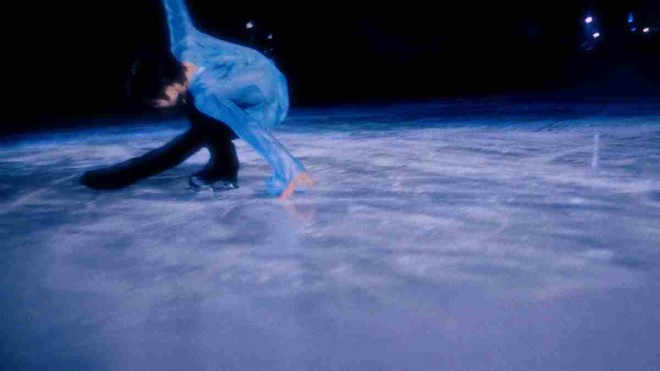
Yuzuru Hanyu skating scene from the music video
FSSp (Flying Sit Spin)
Fans of Medalist will recognize the Flying Sit Spin, a move showcased by protagonist Inori. In BOW AND ARROW, Hanyu incorporates the same move, including the "broken leg" position—where the free leg extends horizontally.
But Hanyu doesn't stop there.
After the broken leg, he transitions into a “sit back” (also known as “sit behind”), a more challenging position where the free leg is placed behind the supporting leg. He finishes the spin with a knee slide, kneeling on the ice, evoking the presence of Medalist character Jun Yodaka.
Quad Salchow + Triple Toe Loop Combination
A rare and bold decision: placing this exhausting combo jump late in the program, around the 2-minute mark. In competition, this strategy carries risk — a failed combo at this point could mean scoring zero for the jump. Hanyu’s confidence here is striking.
Layback Ina Bauer
While not one of the seven required short program elements, Hanyu includes the Layback Ina Bauer as a powerful expressive moment.
This move involves spreading both feet 180 degrees apart, gliding sideways while arching the upper body backward in a deep curve—requiring immense flexibility in the back and hips.
Hanyu performs this move during the lyric, “And all the brilliance you’ve grasped—now it’s yours.” The pose, coupled with his skating history and mastery, brings a poetic resonance to the phrase. It’s a few seconds of pure, unforgettable beauty.
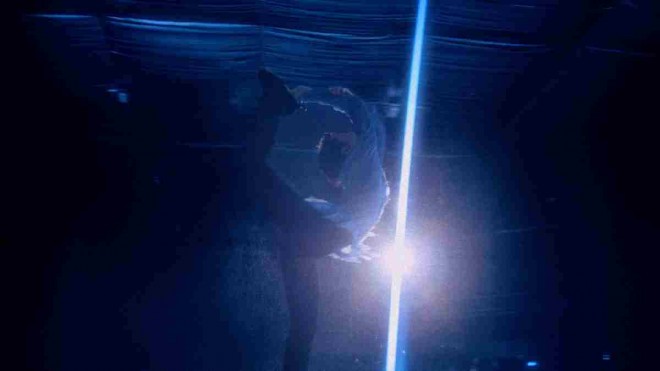
Yuzuru Hanyu skating scene from the music video
4S + 3T (Quad Salchow + Triple Toe Loop Combination)
The jump combination in BOW AND ARROW is a 4S+3T (quad Salchow + triple toe loop), placed in the second half of the program—an unusual and difficult choice.
This sequence occurs around the two-minute mark, after nearly continuous, high-intensity skating. Attempting such a physically demanding combination at this point is extremely challenging.
What’s more, the structure of the short program adds further pressure. Skaters must complete three jumps:
One Axel-type jump
One solo jump
One combination jump
Combination jumps must connect smoothly from the first jump’s landing. To mitigate risk, most skaters place the combination early—so if they miss it, they can still attach another jump later to meet the requirements.
But Hanyu chooses to perform the combination as the third and final jump, leaving no room for error. Missing this could result in a score of zero for that element. His decision reflects absolute confidence in his ability.
Combination Jump at PyeongChang 2018
At the PyeongChang Olympics, Hanyu’s short program jump layout included:
Quad Salchow
Triple Axel
Quad toe loop + triple toe loop
While the jumps were different, he still placed the combination as the third element—a testament to his boldness and strategy.
Source : ORICON NEWS

Related News
Kenshi Yonezu and ‘Medalist’ Creator Discuss Music, Storytelling, and Passion
The music video for "BOW AND ARROW," the opening theme of the anime ‘Medalist,’ was released on March 6 on ...
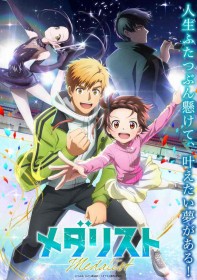
Music Video for the Opening Theme of the Anime Medalist Takes the Internet by Storm – 2 Million Views in Just 12 Hours!
The music video for "BOW AND ARROW," the opening theme of the anime ‘Medalist,’ was released on March 6 on ...
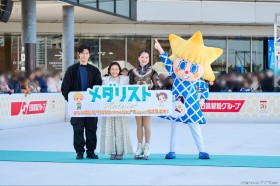
‘Medalist’ Anime Event: Natsumi Haruse & Takeo Ōtsuka Share Behind-the-Scenes Stories – Akiko Suzuki’s Performance Moves the Au...
The TV anime ‘Medalist’ (airing Saturdays at 1:30 AM JST on TV Asahi’s NUMAnimation block), adapted from th...
Top Athletes Recommend! ‘Medalist’ Original Energy Drink "GOE+5000" Now Available for Pre-Order
Acrylic Complex Inc. (Headquarters: Edogawa, Tokyo), known for its original craft syrups inspired by variou...

Medalist Season Finale: Episode 13 Preview and Synopsis Released — Will There Be a Season 2?
The official synopsis and preview cuts for Episode 13, the final episode of the Medalist TV anime, have bee...