


[Editor's Picks] Japan’s Anime Market Is Booming, Yet Studios Are Disappearing Why Production Companies Face a Third Consecutive Year of Bankruptcies
In recent years, global demand for Japanese anime has reached an unprecedented level. Hit titles continue to emerge, and international recognition has driven the market to its largest scale ever. In 2024, the anime market grew four percent year on year to a record 362.142 billion yen, a milestone that should be welcome news for fans around the world.
However, behind this remarkable growth, Japan’s anime production field is confronting a severe crisis.
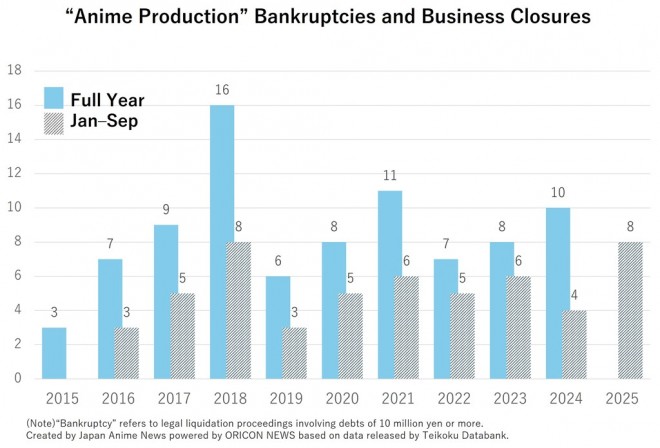
“Anime Production” Bankruptcies and Business Closures, Created by Japan Anime News powered by ORICON NEWS based on data released by TDB
A Growing Market, but Studios Are Still Shutting Down
Despite the industry’s outward success, anime production companies are facing a wave of bankruptcies, suspensions, and closures.
According to research by Teikoku Databank, between January and September 2025, two studios filed for bankruptcy and six more ceased operations or dissolved, pushing a total of eight companies out of the market. This figure is on track to match or exceed 2018, when the annual number of exits hit a record high of sixteen. If the trend continues, 2025 will mark the third straight year of increases in bankruptcies and closures among anime production studios.
Nearly half of the studios that exited the market in the past five years were primary contractors capable of managing full-scale production. Notably, Ekachi Epilka and Cloud Hearts, both responsible for major subcontracting work, went bankrupt during January to September 2025.

Whisper Me a Love Song, for which Cloud Hearts handled production up to Episode 10, had its Blu-ray release canceled in January 2025.
Why Market Growth Isn’t Translating into Studio Profits
This paradox of an expanding market and shrinking production base stems from a core issue widely discussed within the industry: overwhelming workloads without corresponding profits.
Work volume has surged due to global demand, yet studios are unable to pass rising costs on to clients. This structural problem fuels what insiders call “busy but unprofitable” conditions.
1. Rising Production Costs and Labor Expenses
The most significant cost factor in anime production is personnel. As securing young animators becomes increasingly difficult, labor shortages push production costs, wages, and outsourcing fees even higher. Yet revenue growth is insufficient to offset these escalating expenses.
2. Yen Depreciation and Its Impact on Outsourcing
To respond to sudden increases in global demand, some studios outsourced work to companies outside Japan. But rapid yen depreciation following the pandemic caused overseas outsourcing costs to spike dramatically, worsening profit margins instead of stabilizing them.
3. Structural Inequality Favoring Large Companies
Small and mid-sized studios , especially those without stable intellectual property (IP) revenue , are especially vulnerable. Without strong in-house IP, they struggle with declining production volume and rising subcontracting costs, often resulting in losses.
In fact, in 2021, 39.8 percent of anime production companies reported red ink, the highest figure on record. Among specialized subcontract studios, the number soared to 42.6 percent, underscoring a growing performance gap between industry leaders and smaller firms.
From “Art” to “Science”
Another challenge stems from the nature of anime production itself. Many creators, driven by the desire to make something better, tend to pour additional time and resources into improving quality, even when it hurts profitability.
A key determinant of whether studios survive financially is whether they have staff who can manage production as a business, people who can track numbers and whose advice studio heads, often creators themselves, are willing to heed.
The greatest source of cost overruns is schedule delays. To stop financial bleeding, studios must strengthen schedule management, numerical planning, and upstream project oversight, not just financial controls.
The industry is increasingly recognizing the need for management frameworks that treat anime production not only as intuitive, creator-driven “art,” but also as a sustainable “science” supported by systems and organization.
Social Media and the Rise of “Art Critics”: The Pressure of Animation Quality
Social media has made fans an active part of shaping a work’s reputation. However, it has also intensified scrutiny of “animation quality,” creating new hurdles for studios.
For example, Blue Lock Season 2 (Winter 2024) was mocked on YouTube for scenes that looked like stitched-together still images. Personally, I did not find it distracting until I saw the criticism online.

Blue Lock Season 2
Similarly, One-Punch Man Season 3 (Fall 2025) was called out for its frequent static shots, leading to endless comparisons with the staff and studio from Season 1.
.jpg)
One-Punch Man Season 3
In The Apothecary Diaries, a long-shot sequence where characters’ faces were intentionally simplified became a viral topic on X, with some claiming it was “lazy animation,” despite the fact that such stylistic omission is a recognized technique.
でもやはり引きの人物の手抜きが気になる。いくらほかの部分がぬるっと動いてもこれじゃ幻滅。台詞ありのカットだから余計にひどく感じる。せっかく才能があるんだからつまらない手の抜き方するなと。手描きが無理ならCGで代替するとか少しは頭を使えばいいのに #薬屋のひとりごと pic.twitter.com/zybR9cKihq
— アニミスク (@animisc) October 28, 2023
Even “in-betweens,” the frames used to connect key animations smoothly, have been misinterpreted as “animation collapse” when removed from context — the Sasuke scene in Naruto Episode 29 being a famous example.
知識のない視聴者から頻繁に「作画崩壊」と言われるコマが、動画の中でいかに重要な意味を持っているのかの解説(英語) https://t.co/P3paiS73Rk
— 大童 澄瞳/Sumito Oowara (@dennou319) July 2, 2020
Excessive expectations from fans may be another factor contributing to production fatigue.
Conclusion
The global reputation of Japanese anime remains strong, and its appeal as a cultural powerhouse is unquestioned. Yet the profitability of the studios that uphold this quality has been declining year after year.
Teikoku Databank stresses the urgent need for improvements such as fairer business practices and stronger animator training programs to ensure sustainable growth.
In North America and other regions, streaming platforms are beginning to pursue long-term co-production agreements and animator-support initiatives, aiming to coexist with Japanese studios by investing in high-budget collaborative projects.
To preserve Japan’s world-class creativity for the future, the industry must build mechanisms that ensure revenues from hit titles are properly returned to production companies.
For fans to continue enjoying top-tier Japanese anime, studios must grow stronger financially, combining creative passion with sustainable operational strategies. This is not merely an economic issue but a critical challenge that will shape the future of the anime we love.
Source : TBD Official

Related News
[Editor's Picks] Chainsaw Man: Reze Arc Dominates Japan’s Box Office with Momentum Toward the 10-Billion-Yen Milestone, Earning...
Chainsaw Man: Reze Arc surpasses 5 billion yen at Japan’s box office. With Tatsuya Yoshihara’s acclaimed di...
![[Editor's Picks] Chainsaw Man: Reze Arc Dominates Japan’s Box Office with Momentum Toward the 10-Billion-Yen Milestone, Earning Praise for Its New Director](/upimg/thumb/6000/6573/img280/Chainsaw-Man-Reze-Arc-visual2.jpg)
[Editor's Picks] Looking Back on Summer 2025 Anime: 5 Must-Watch Recommendations
As the summer 2025 anime season comes to an end, we look back at the standout titles that defined these pas...
![[Editor's Picks] Looking Back on Summer 2025 Anime: 5 Must-Watch Recommendations](/upimg/thumb/6000/6528/img280/2025-summer.jpg)
[Editor's Picks] Middle-Quality Anime Becomes a Hot Topic: Style of Hiroshi Nohara’s LUNCH Goes Viral with Over 1.7 Million Views
The term Middle-Quality Anime is rapidly spreading in Japan’s anime industry. The DLE-produced anime Style ...
![[Editor's Picks] Middle-Quality Anime Becomes a Hot Topic: Style of Hiroshi Nohara’s LUNCH Goes Viral with Over 1.7 Million Views](/upimg/thumb/6000/6743/img280/Style-of-Hiroshi-Noharas-LUNCH-Goes-4.jpg)
[Editor's Picks] Predicting the Next Manga Award 2025
The 2025 Next Manga Award results will be announced on September 18 at 7:00 p.m. JST, exactly 24 hours afte...
![[Editor's Picks] Predicting the Next Manga Award 2025](/upimg/thumb/6000/6235/img280/next-manga-awards2025.jpg)
[Editor’s Picks] Too Many Anime? Broadcast Delays Become an "Unusual Situation" as Six TV Series Are Postponed and One Canceled
As the summer anime season concludes and new titles from the fall season begin airing, the industry faces a...
![[Editor’s Picks] Too Many Anime? Broadcast Delays Become an "Unusual Situation" as Six TV Series Are Postponed and One Canceled](/upimg/thumb/6000/6362/img280/Fall-Anime-Broadcast-Delays.jpg)
[Editor’s Picks] Why Do Anime Episodes Get Delayed? Exploring the Reasons Behind Broadcast Interruptions and Hiatuses
Why are anime episodes delayed or paused? Learn about production delays, network schedules, and the realiti...
![[Editor’s Picks] Why Do Anime Episodes Get Delayed? Exploring the Reasons Behind Broadcast Interruptions and Hiatuses](/upimg/thumb/5000/5148/img280/combined_anime_images.jpg)