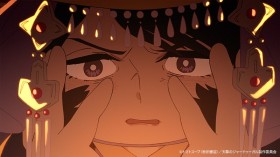
Special Interview: Executive Director Naoko Yamada on Jaadugar: A Witch in Mongolia
Jaadugar: A Witch in Mongolia, the historical court drama set in the 13th century Mongol Empire. Why did the series resonate so deeply with viewers? We spoke with Executive director Naoko Yamada.
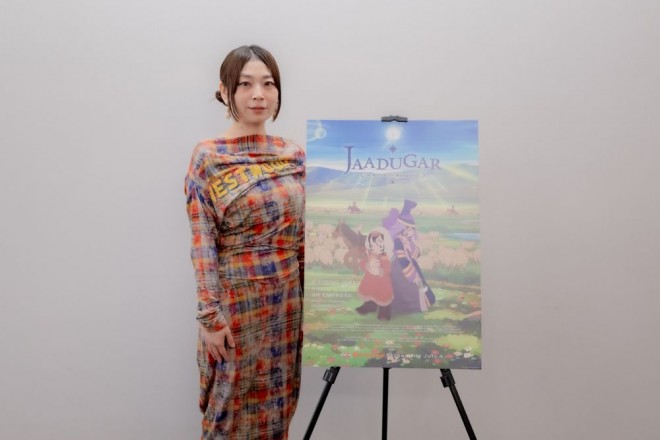
Naoko Yamada
How was it seeing the reactions of the fans who attended the preview screening? Please tell us if there were things that went as expected, or differently.
I am glad we received a huge round of applause. Seeing the fans watching quietly and intently made me genuinely proud of this work myself. Watching it on the big screen, it reinforced my feeling that we made a truly wonderful anime.
©Tomato Soup(AKITASHOTEN)/Jaadugar Committee
How do you divide the roles with Director Abel in this work? Also, did you have any conversations before starting production on this project?
As for the initial goal or vision when we started making this anime, during the script meeting stage, we talked about a workflow where I would solidify the key points and the direction we were aiming for, and from there, I would pass the baton to Abel-san for the animation, visuals, sound, and so on. Right around the time we were checking the submitted storyboards together, our roles crossed over, and from there I gradually faded out. It wasn't cleanly split, but that’s how things ended up taking shape in the end.
©Tomato Soup(AKITASHOTEN)/Jaadugar Committee
We would love to hear about any synergy born precisely because it was a collaboration between the two of you, and any points you particularly want overseas fans to see.
Normally, it's difficult to objectively view the works I direct myself or to understand my own role, so there are times when I lose sight of things, wondering, "What does a director actually do? What should I be doing?" Therefore, working with Abel-san this time was a great opportunity to see up close how a director works with the staff, and I learned a tremendous amount.
Abel-san holds a lot of love and respect for old Japanese films and animation, but beyond that, he also has a broad interest in various arts, music, and cultural disciplines. I think he is someone who is incredibly good at outputting the things he has accumulated within himself in the best possible way for the project. Not only is he a wonderful creator, he can also think about things very logically and is also extremely good at expressing subtle, emotional nuances that are hard to put into words. Overall, I think he is someone who creates works with a really flexible and versatile approach.
©Tomato Soup(AKITASHOTEN)/Jaadugar Committee
In contrast to original author Tomato Soup's cute art style, I believe the actual story deals with heavy themes. Were there any things you kept in mind when expressing that gap?
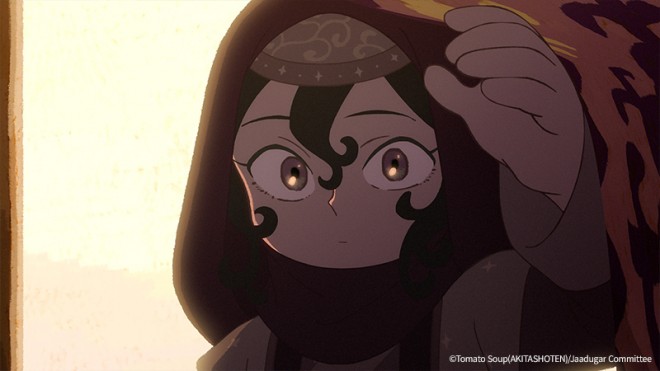
I think I just had to tackle it earnestly and straightforwardly. The gap between the art and the content of the story is the greatest appeal of this work. I felt it was important not to do anything eccentric, but to just portray it straight on.
©Tomato Soup(AKITASHOTEN)/Jaadugar Committee
With global streaming in mind, we would appreciate it if you could tell us if there was anything you were conscious of in terms of direction to attract both Japanese and overseas viewers.
This is strictly my way of thinking, so I don't think Abel-san’s answer would be the same, but I believe that fundamental human emotions cross borders. I didn’t consciously exaggerate anything just to target an overseas audience. My stance is to "believe things will be understood, and trust the audience," and this doesn’t change whether it’s for Japan or abroad. In that sense, I consciously made a point not to do anything special for them.
©Tomato Soup(AKITASHOTEN)/Jaadugar Committee
In the original work, the food culture of foreign lands is also depicted meticulously. When you actually ate the local food, did you have any favorite dishes?
We got to do a homestay at the home of some nomadic people, and we ate the meals made by the mother of the household. Truthfully, I don’t really like mutton much. However, in Mongolia, mutton is like a staple food in the region, so I was wondering how it would go, but when I ate it, it was truly delicious. The meat was fresh, and the locals really know the best ways to make it taste great.
Also, a traditional Mongolian local dish called tsuivan, which is similar to fried udon, was really delicious.
©Tomato Soup(AKITASHOTEN)/Jaadugar Committee
Please let us know if there are any scenes or points you particularly want people to pay attention to in this work. (We would be happy with deeply geeky/niche points like "Actually...")
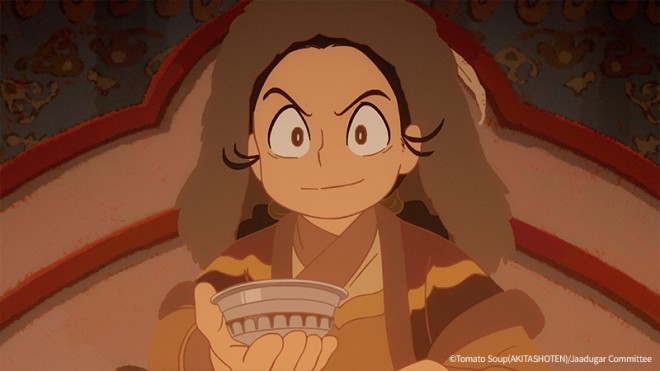
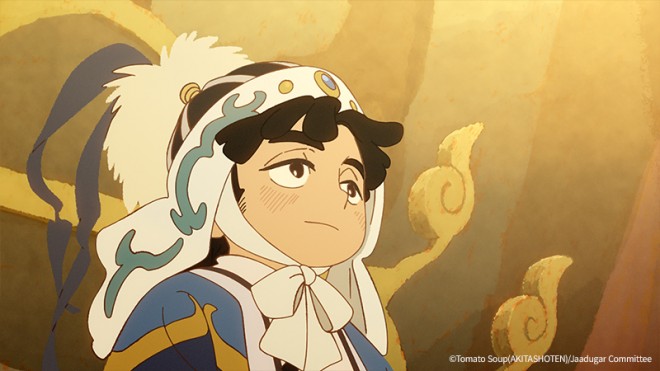
Ögedei has a famous historical reputation for being a big drinker. Abel-san made it a point that whenever Ögedei appears, he is always happily drinking. He makes him drink at every given opportunity (laughs). I really felt the love in that, so those are some of my favorite scenes. Among Mongolian alcohol, there is a liquor called airag, which is fermented raw mare's milk. There are also distilled spirits like vodka, but airag is cloudy white and relatively low in alcohol content, making it easy to try, I think.
©Tomato Soup(AKITASHOTEN)/Jaadugar Committee
Please give a message to the viewers.
Nowadays, I think we live in a world where you can easily get information on the internet and such, but I personally feel that we have become so overly comfortable with or accustomed to that abundance of information that our opportunities to just stop and think about something have decreased. When you watch this anime, I feel like you can pause just a little bit, thinking, "I want to think about this a bit more," or "I want to know a bit more." The subject matter isn’t exactly overly difficult or anything, but I think it's a work that gives your brain a nice stretch. By all means, I hope everyone can enjoy that feeling.

Related News
Jaadugar: A Witch in Mongolia Episode 10 Story & Preview Cuts Released: Sitara Strives to Fulfill Her Oath to Toregene
The story and preview images for Episode 10 of the TV anime Jaadugar have been revealed. This episode will ...
Jaadugar: A Witch in Mongolia Episode 9 Story & Preview Cuts Released: The Mongol Empire Reaches Its Peak, But Something Is Wro...
The story and preview images for Episode 9 of the TV anime Jaadugar have been revealed. This episode will a...
Jaadugar: A Witch in Mongolia Episode 8 Story & Preview Cuts Released: Sitara Uses Her Knowledge to Win Over the Empress
The story and preview images for Episode 8 of the TV anime Jaadugar have been revealed. This episode will a...
Jaadugar: A Witch in Mongolia Episode 7 Story & Preview Cuts Released: Sitara's Revenge Plan Begins
The story and preview images for Episode 7 of the TV anime Jaadugar have been revealed. This episode will a...
Jaadugar: A Witch in Mongolia Episode 6 Story & Preview Cuts Released: Kuroe Targetted by Gyaru Influencer Rairi
The story and preview images for Episode 6 of the TV anime Jaadugar have been revealed. This episode will a...
Jaadugar: A Witch in Mongolia Episode 5 Story & Preview Cuts Released: Kuroe Targetted by Gyaru Influencer Rairi
The story and preview images for Episode 5 of the TV anime Jaadugar have been revealed. This episode will a...